1830 Census Records: Decode Age Groups and Find Families
American Genealogy Records · 1830 Census Records
The 1830 census can help trace an older American branch of your family, but most people on its pages are represented by counts rather than names. The challenge is to compare a household pattern with people documented elsewhere. Learn how to read those counts without turning an unnamed person into an unsupported ancestor.
What does the 1830 census tell you?
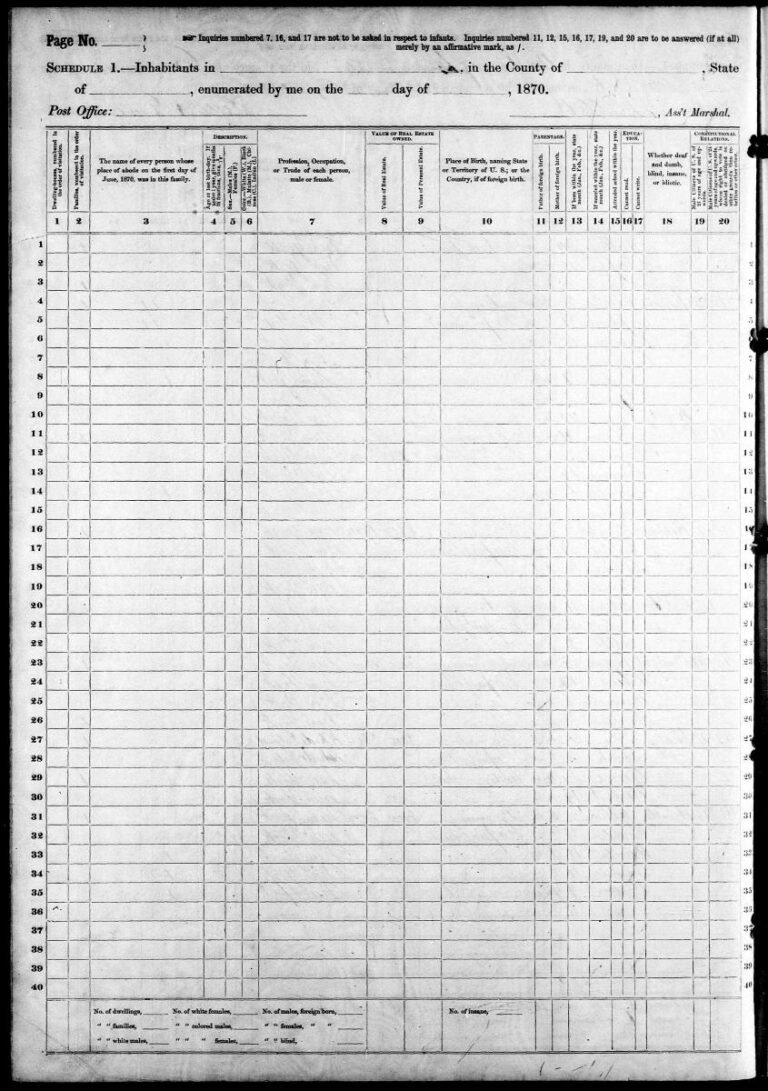
The schedule names household heads and groups other residents into categories, including age and sex. It does not give every person’s name or a complete set of family relationships. Use the National Archives 1830 guide and the original questionnaire to identify the headings before reading the numbers.
This census is useful when a family branch was already in the United States by 1830. It can also help with an American-born spouse’s older ancestry in a mixed family tree. If your documented immigrant arrived much later, do not force that person into an early household simply because the head shares a surname.
Where can you search 1830 census records?
Start with the National Archives online collection links. Select the 1830 population census and check the provider’s image access conditions. NARA lists FamilySearch as free with account creation; other providers and library access routes may have different requirements. Make sure that you can inspect the underlying page, not just a transcription.
Search the expected household head, allowing spelling variants and a wider locality when justified. A wife or child generally cannot be found through a direct name search if the original schedule does not name that person. Search possible heads whose identities and locations are supported by other records, then compare their household counts.

Read the age bands one column at a time
The official census day was June 1, 1830. The schedule uses age bands rather than exact ages for most residents, and the bands differ across its historical categories. Do not assume that every set of columns uses identical intervals. Copy the heading for each count before assigning it to a person in your notes.
Translate the band into an approximate birth period, preserving the original wording alongside your calculation. Someone in a five-to-under-ten group is not documented as a specific seven-year-old. If a later record supplies an age, ask whether it is compatible with the band rather than making the census provide precision it never contained.
Create a worksheet with columns for the original category, age band, count, possible identity, and evidence for that identity. Leave the last two blank until you have a reason to fill them. This prevents a convenient arrangement of names from gradually becoming a supposed transcription of the original census.
A compatible count is a hypothesis, not a named child
Imagine a hypothetical family with a documented son who would have been about eight in 1830. A candidate household contains one boy in a compatible band. That is a reason to investigate the household, but it does not identify the boy. Several families may have children of similar ages, and the household may include someone other than a son.
Look for a record that explicitly connects the generations, such as a church entry, estate document, or later record identifying parents. Keep the census as supporting residence and household evidence. If the direct connection remains missing, say so in your research summary instead of presenting the anonymous count as a named individual.
Compare 1830 with 1840 without requiring identical households

Advance each possible person by ten years and compare the resulting pattern with the 1840 household. Allow for people leaving home, marriage, births, deaths, and other changes. The household is not expected to remain a fixed group. Explain why each proposed identity remains plausible despite any differences.
When the head disappears, search a possible widow or adult child as a new head, but do not assume that every nearby person with the same surname is related. Investigate whether the place name or county boundary changed. A different county label may reflect a jurisdictional change, a move, or a completely different family.
Use the named 1850 household as another test

Work backward from a well-identified 1850 family and compare likely survivors with the earlier age bands. Do not assume that an older adult in 1850 headed a household in 1830. The person might have lived in someone else’s home, and the available evidence may not yet identify that head.
Where two candidates fit, give each a separate worksheet. Compare locality, associated surnames, property records, and later family documents. A detailed explanation of why one candidate was excluded is useful evidence for your final conclusion. Do not choose between them simply because one search result appears first.
Distinguish historical categories from modern identity
The form records separate historical categories for free white people, free people of color, and enslaved people, with different age groupings. Read the original headings to understand what was counted. These classifications reflect the record’s historical system and should not be treated as a complete modern description of a person’s identity or ancestry.
For an enslaved ancestor, household counts alone cannot generally establish a personal name. Begin with an identified person in later sources and investigate the relevant locality, estates, deeds, and other surviving records. Preserve possible links as possibilities until the evidence can distinguish the individual from others of similar age.
What if the family is missing?
Check the National Archives coverage notes before repeating a failed search. Surviving records are not complete for every locality. Confirm the historical jurisdiction, try justified surname variants, and browse likely pages when an index seems unreliable. Note whether the issue is missing records, missing indexing, or simply an unsuccessful search.
Use local tax, land, court, church, or probate records when they survive and fit the question. Keep a dated timeline of actual appearances rather than filling the gap with assumptions. A record created in 1832 may help investigate an 1830 location, but it does not automatically prove residence there on census day.
Frequently asked questions about the 1830 census
Can I search directly for my ancestor’s wife or child?
Usually the schedule does not name those residents individually. Investigate an identified household head and compare the counts with family evidence from other records.
Does a matching age group prove the person is my ancestor?
No. It supports a possible fit. You need additional evidence connecting the named person to that household and distinguishing competing candidates.
Does this census identify a foreign birthplace?
It does not provide each resident’s country of birth. Investigate origin through other documents rather than assigning a country to an unnamed household count.
Sources and research tools
- Official 1830 census research guidance
- Census Bureau: 1830 questionnaire and instructions
- National Archives: search census records online
How we can help
PoloniaRoots researches American and Polish documents to test family connections and identify the right ancestral locality. Review our research projects and prices, choose a scope, and complete payment before sending family details through the order form. Include your existing documents, source references, and unsuccessful searches. The outcome depends on surviving evidence; a particular discovery cannot be guaranteed.