Chapter 4 · Life in America · Polish-American parishes
In a Polish parish in America the priest usually spoke Polish, knew the Polish forms of names and asked where people came from. So these registers, kept in Latin or Polish, name a parish in Poland more often than most American records, yet few families ever ask for them.
Need to connect your family’s American parish records to Poland? See genealogy research packages for American families, from $1,290 USD, with an English report and translations.
Why Polish parishes recorded the home parish
Polish immigrants built national parishes, which served a language group rather than a territory, and many of their priests were born or trained in Poland. A priest who knew the Polish form of a surname rarely anglicized it, though he could still misspell an unfamiliar village. Church law also required him to confirm that a couple was free to marry, which meant asking where each had been baptized.
What the registers contain
- Baptisms: dates of birth and baptism, both parents with the mother’s maiden name, the godparents, and sometimes the parents’ parish in Poland
- Marriages: the couple, their parents, two witnesses and often each spouse’s parish of baptism
- Burials: date, age, cemetery, sometimes the birthplace
- Margin notes on a baptism recording the person’s later marriage
Marriage investigation files
Where the priest’s prenuptial investigation papers survive, they can say more than the register: a baptismal certificate sent from Poland, the parents’ names and birthplaces, or witnesses’ statements when no certificate could be had. Ask whether they exist for your year.
Finding the right parish
Registers are filed by parish; the Archdiocese of Detroit notes it has no central database searchable by name alone. A Polish family often walked past a nearer church to reach the Polish one.
- The address from a census or city directory; many directories also list churches
- Sanborn maps, which show churches on the street plan
- Obituaries and Polish-language death notices, which often name the church of the funeral Mass
- Parish jubilee books, which list founding families and societies
- Diocesan parish lists; Chicago’s archdiocesan archives publish one with maps, each parish’s ethnicity and where its records are now

Closed and merged parishes
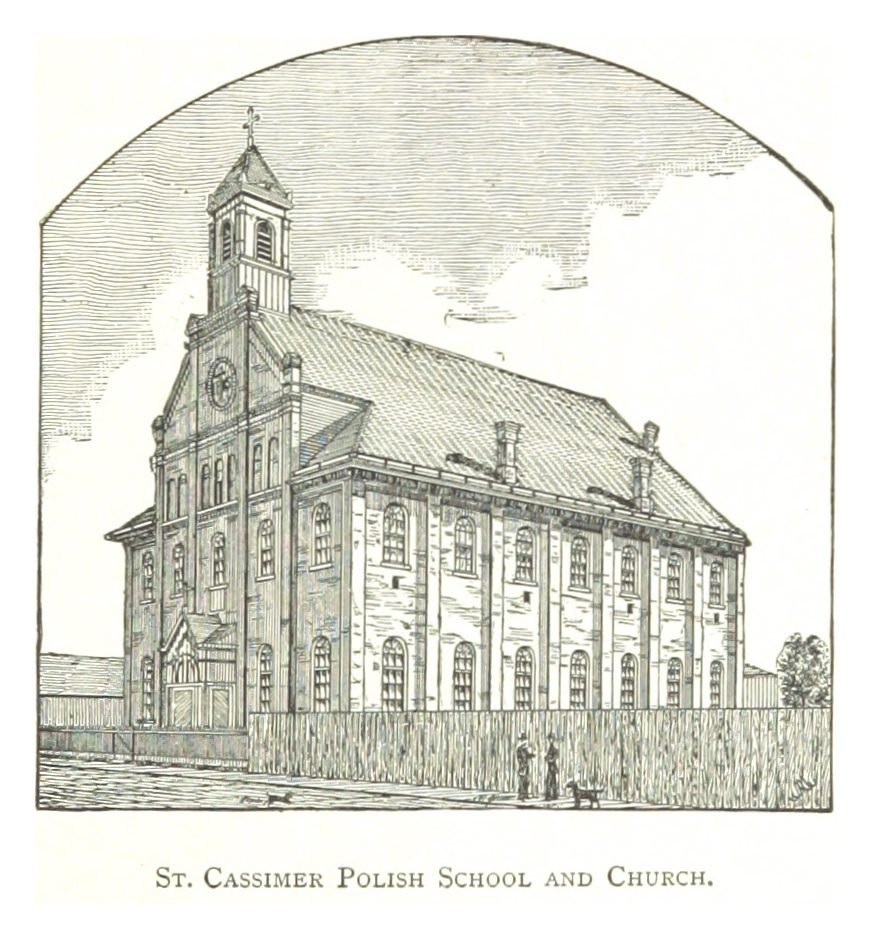
A closed parish’s books go either to the parish that absorbed it or to the diocesan archive, and dioceses draw the line differently. In Baltimore, the records of the Polish parish of St. Stanislaus Kostka are held by St. Casimir Parish. Detroit’s archives hold parishes that closed without merging; merged parishes keep their own books. Buffalo’s archives hold city churches closed before 1994; merged churches’ records stay with the receiving parish.
How four dioceses handle genealogy requests
| Diocese | What genealogists can get | How to ask |
|---|---|---|
| Archdiocese of Chicago | Information from closed parishes’ registers before January 1, 1926; open parishes hold their own books | In writing, with a processing fee and a copy of a state photo ID |
| Archdiocese of Milwaukee | Events before 1921; a copy of the entry and a translation; a donation is appreciated | Online form only, no phone or email; replies in 2 to 6 weeks |
| Diocese of Scranton | Records 70 years and older | Write to the parish holding the registers; the Northeast Pennsylvania Genealogical Society has copies |
| Diocese of Buffalo | No genealogy or dual citizenship service from the diocese | The diocese points researchers to the Grosvenor Room of the Buffalo and Erie County Public Library and to genealogical societies |
Policies change: Detroit’s archives have at times stopped taking new genealogy requests because of staffing. Check the current rules and fee before you write.
Registers you can browse online
FamilySearch has free images in Illinois, Chicago, Catholic Church Records, 1833-1925; most registers there end in 1915. Findmypast has Philadelphia’s archdiocesan baptisms and marriages before 1920, and its Catholic Heritage Archive holds Baltimore’s registers over 100 years old, free to browse. Browse page by page, since an index can miss a Latin or Polish name.
Reading the entry
| Latin | Polish | English |
|---|---|---|
| baptizatus | ochrzczony | baptized |
| natus | urodzony | born |
| patrini | chrzestni | godparents |
| copulati | zaślubieni | married (the couple) |
| testes | świadkowie | witnesses |
| sepultus | pochowany | buried |
| ex parochia | z parafii | from the parish of |
| nata, de domo | z domu | née, maiden name |
Step by step
- Find the family’s address, then the nearest Polish parish, not just the nearest Catholic one
- Learn whether it is open, closed or merged, and who holds its books
- Check FamilySearch or Findmypast, then the diocese’s current policy on dates and fees
- Ask for a copy of the entry itself, giving parish, sacrament, approximate date and both parents
- Request every child’s baptism; godparents differ from entry to entry
A worked example (hypothetical)
Józef Kania and Anna Sowa, invented for this example, married in a Polish parish in Milwaukee in 1910, within the archdiocese’s pre-1921 rule. The Polish entry gives the groom as “z parafii Dąbrowa, gub. płockiej”. Dozens of villages share that name; the governorate narrows it to the Płock region. At their first child’s baptism a godfather is also from “Dąbrowa”, which supports the reading. Next: identify which Dąbrowa in that governorate was a parish seat and search its registers.
If baptisms stop suddenly, check the Polish National Catholic parish in the same town, whose registers the Roman Catholic diocese does not hold.
An entry is only as accurate as what the family said and the priest heard. Treat the village as a strong lead and confirm it in Polish records.
Sources and research tools
- Archdiocese of Milwaukee: genealogical records policy and request
- Archdiocese of Baltimore: sacramental records and closed parishes
- Diocese of Scranton: genealogical research
How we can help
FOCUS10 offers 10 research hours for $1,290 USD on one focused question, such as investigating a village clue in American parish and civil records. For one family line across American and Polish sources, ESSENTIAL25 provides 25 hours for $2,900 USD. Access depends on the parish or diocese and the dates involved; a particular entry or birthplace cannot be guaranteed. Compare the research packages and completion estimates.
Keep reading
US death records and obituaries
Catholic church records in the US: how to request them