What Is a Half Cousin? Family Trees and DNA Explained
Family History Research · What Is a Half Cousin? Family Trees and DNA Explained
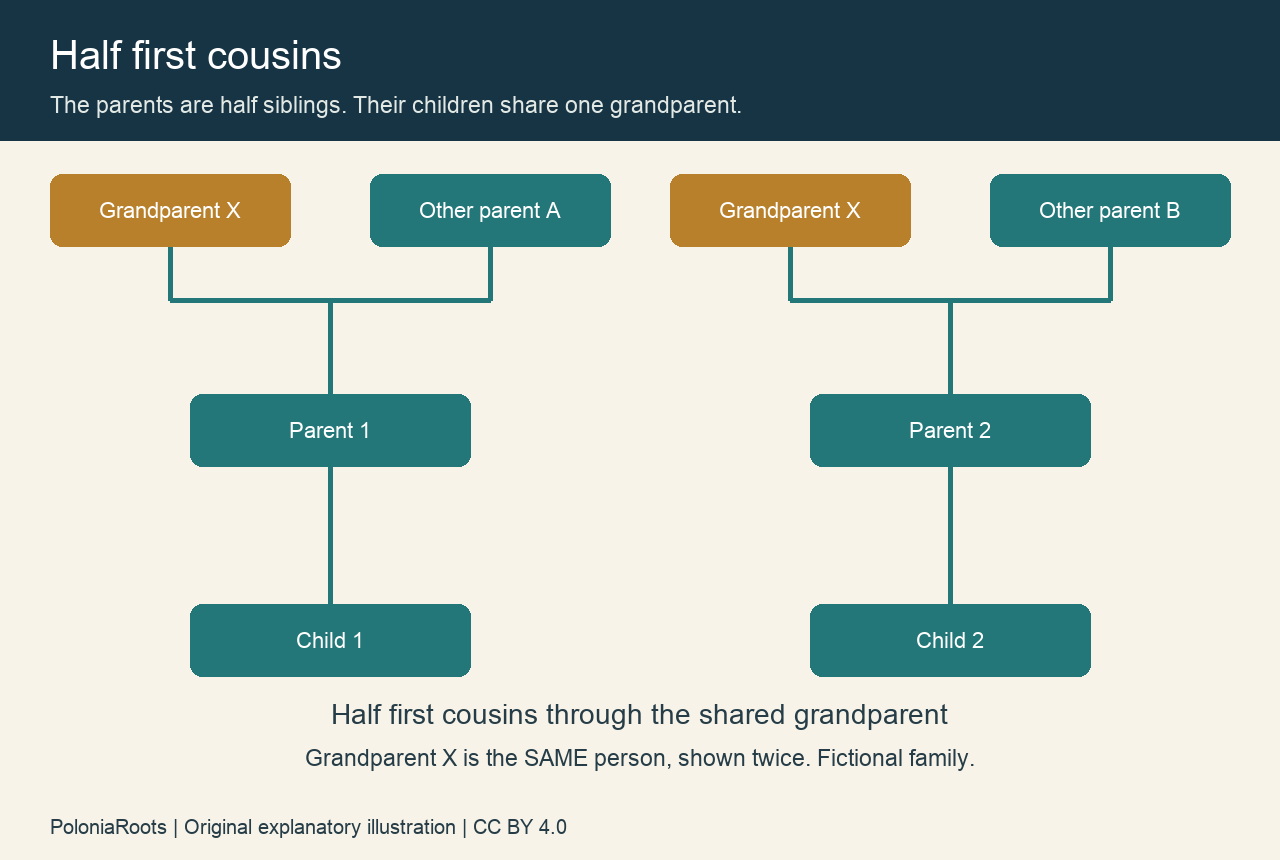
A half first cousin is the child of your parent’s half sibling. You and that cousin share one grandparent through this relationship, while ordinary first cousins share a grandparent pair. The word half describes the ancestral path, not half a person or a less meaningful family bond. If a DNA platform suggests a half cousin relationship, investigate the family tree before treating the label as established.
What does half cousin mean?
Suppose your mother and her brother share a father but have different mothers. They are half siblings. You and the brother’s child are half first cousins through that shared grandfather. The same principle applies on any parental side: the connection is through one shared grandparent rather than both grandparents of an ordinary first cousin pair.
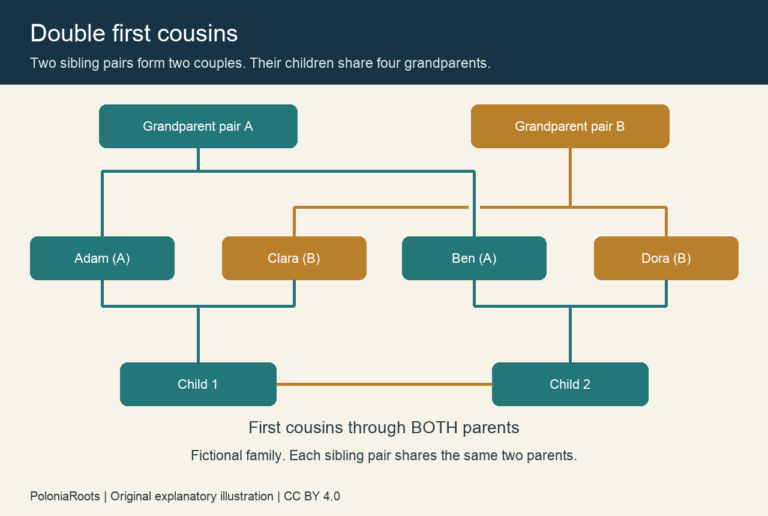
Use the full relationship term when possible. Half first cousin, half second cousin, and half first cousin once removed are different positions in a family tree. The cousin degree depends on the generations back to the common ancestor; removed describes a generation difference between the two people. The word half alone does not tell you either detail.
Half cousin vs. first cousin, step cousin, and cousin once removed
| Term | How the connection works |
|---|---|
| First cousin | Your parent and the cousin’s parent are full siblings. |
| Half first cousin | Your parent and the cousin’s parent are half siblings. |
| First cousin once removed | An ordinary first cousin relationship with one generation difference, such as a first cousin’s child. |
| Step cousin | An informal family relationship formed through a stepfamily connection; it does not itself establish a shared biological ancestor. |
A step relationship and a half relationship are not interchangeable. A half sibling shares a biological parent; a step sibling relationship arises through a parent’s partnership and does not by itself imply shared ancestry. A person can also have more than one connection to a family, so record the actual paths rather than forcing every relationship into one label.
How much DNA do half first cousins share?
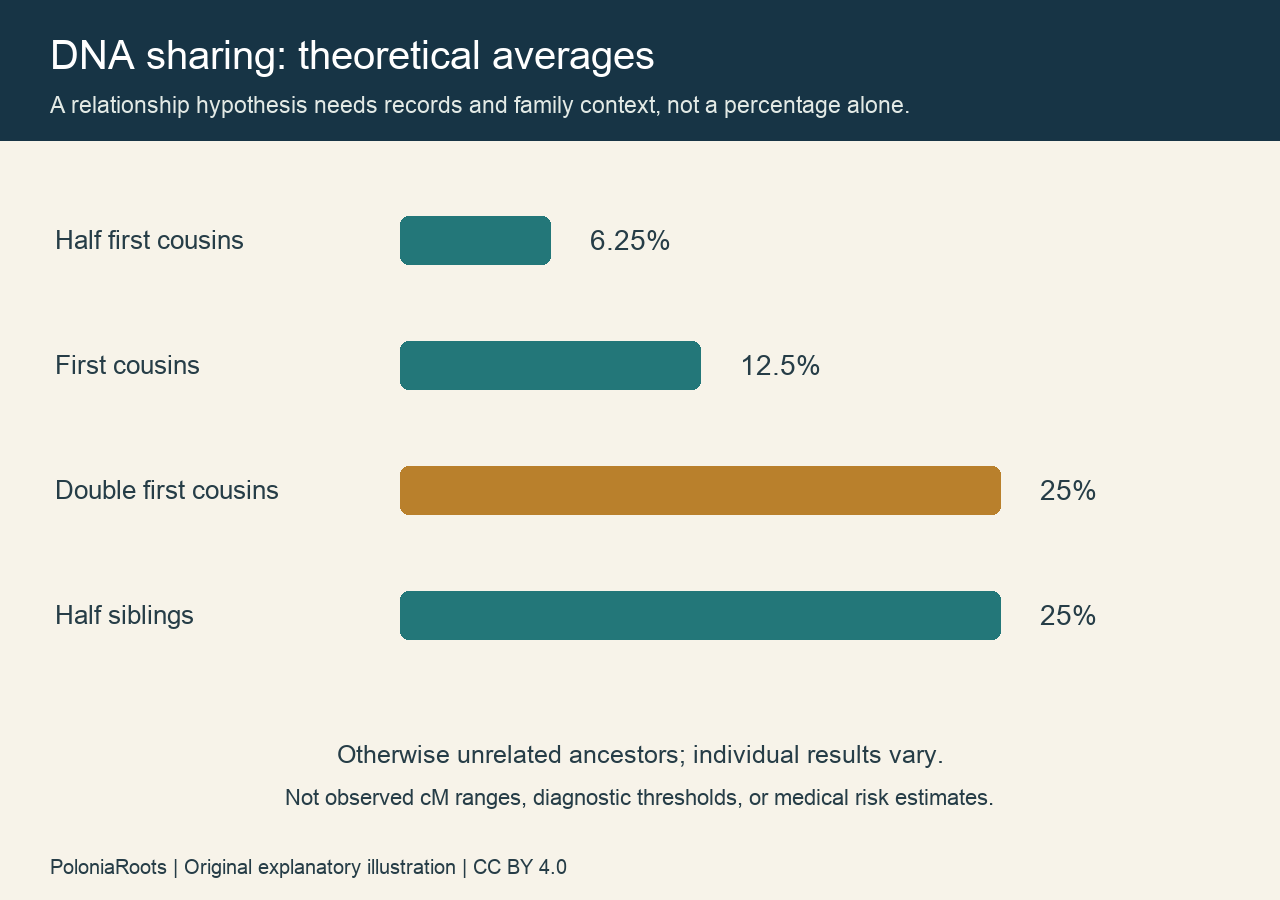
In a simple pedigree with otherwise unrelated ancestors, half first cousins have an expected autosomal sharing of about 6.25%, compared with about 12.5% for ordinary first cousins. These are theoretical averages. An individual pair can share more or less, and the ranges for different relationships overlap. A percentage or cM total should generate hypotheses, not settle the family tree by itself.
The Shared cM Project tool on DNA Painter is a research aid for comparing possible relationships. Read the tool’s notes and limitations. Add the testers’ ages, known relatives, locations, and documentary evidence before deciding which possibilities fit. Do not assume a relationship is impossible merely because it differs from the first label shown by a testing company.
Why a DNA service may predict a different relationship
Testing platforms infer possible relationships from shared DNA and other information available to the service. They do not necessarily know the complete family structure. Ancestry’s guidance on discovering relationships to matches encourages comparison with family trees and shared matches. The display label is a starting point for that investigation.
An unexpectedly high or low amount can have several explanations, including an alternative relationship or more than one ancestral path. Check what is already known before drawing a conclusion about an unknown parent. If an account lacks the necessary shared-match or tree access, note that limitation. A missing tool is not negative evidence against a proposed relationship.
How to investigate a possible half cousin
- Write the proposed relationship as a path from each tester to the common ancestor.
- Document the two parents and test whether they shared one parent or both.
- Compare dates and places so that people with similar names are not merged.
- Look for known relatives whose matches could help identify the branch.
- Keep competing relationships in the working notes until the evidence distinguishes them.
- Explain the conclusion, confidence, and remaining gaps in writing.
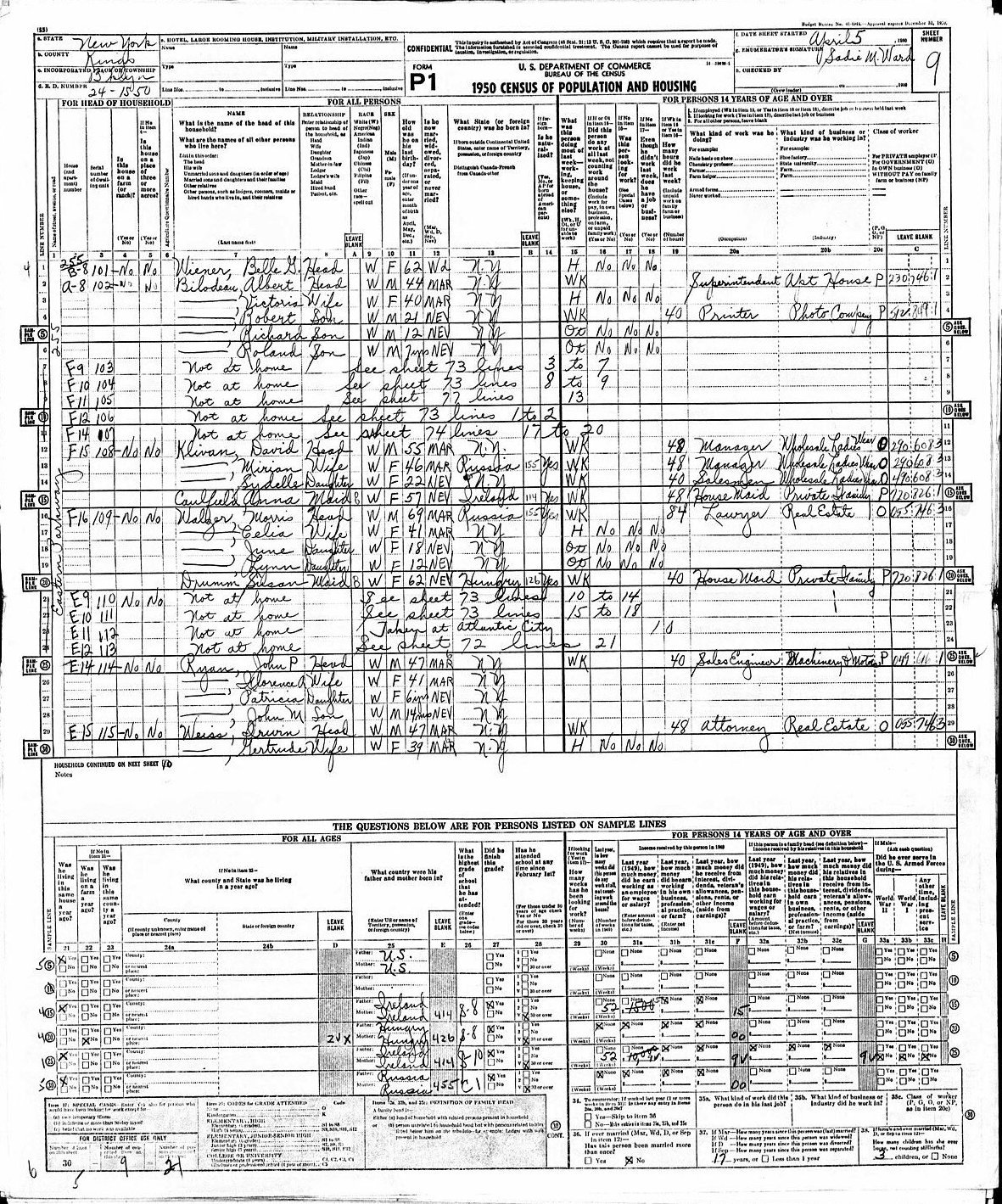
Birth and marriage records can identify parents, while censuses and directories can establish household and residence context. Remarriage can create a household containing full siblings, half siblings, and step siblings. Read each document according to what it actually states; a household listing alone does not resolve every biological connection.
A fictional example with two households
This example is fictional. Daniel’s grandfather had a son in an earlier relationship and a daughter in a later relationship. Daniel descends from the daughter; a DNA match descends from the son. If the two children shared the same father but had different mothers, Daniel and the match are half first cousins through that grandfather.
To support that conclusion, the researcher needs evidence for the grandfather’s identity in both families and the descent of each tester. A repeated name is not sufficient. Addresses, occupations, event dates, and related relatives can help distinguish two men with similar names. If a document conflicts with the hypothesis, record the conflict and investigate it.
Handle unexpected family information thoughtfully
A DNA match can raise personal questions for living relatives. Separate a tentative explanation from a supported conclusion, and consider privacy before sharing either. Ask the test owner for authorization before accessing or distributing results. Use the platform’s approved sharing controls rather than exchanging account passwords.
Genealogical analysis explains relationships. It does not convert a half cousin label into a diagnosis or a prediction of inherited disease. If the research question concerns family health history, distinguish the documentary findings from clinical assessment and discuss medical questions with an appropriate professional.
Frequently asked questions
Are half cousins biologically related?
Yes, when the term describes a biological half cousin path. Half first cousins share one grandparent through that path. Establish the actual ancestors rather than relying on an informal family label.
Is my parent’s cousin my half cousin?
A parent’s ordinary first cousin is your first cousin once removed. A half relationship requires a half sibling connection somewhere in the relevant path; a generation difference alone does not create it.
Does about half the expected DNA prove half cousins?
No. The amount varies and can fit different relationships. A conclusion needs the family structure, documentary evidence, and relevant DNA comparisons.
Sources and research tools
- FamilySearch: cousin relationship chart
- DNA Painter: Shared cM Project tool and notes
- Ancestry: discovering relationships to matches
- MyHeritage: interpreting results with genealogical evidence
How we can help
PoloniaRoots offers DNA Match Analysis for $2,750: one existing autosomal test on AncestryDNA or MyHeritage, one platform, and one defined family-history question. The work combines available matches, family trees, and documentary evidence in a written report. It does not include a new laboratory test, clinical interpretation, or a guaranteed identification. Review the scope and pay before submitting your research details. Use approved sharing permissions; do not send account passwords or raw DNA through a public form.