US Records · Delayed birth certificates
Many Americans born before uniform state registration had no timely civil birth certificate. When they later needed proof for Social Security, a passport or employment, they could apply for a delayed certificate supported by older records and sworn statements.
Why a delayed record was created
The document was registered years after the birth, often in adulthood. It is not a newly discovered original certificate. It is a legal reconstruction based on evidence available when the application was made.
Evidence that may appear in the file
- Baptismal or parish certificate
- Early census or school record
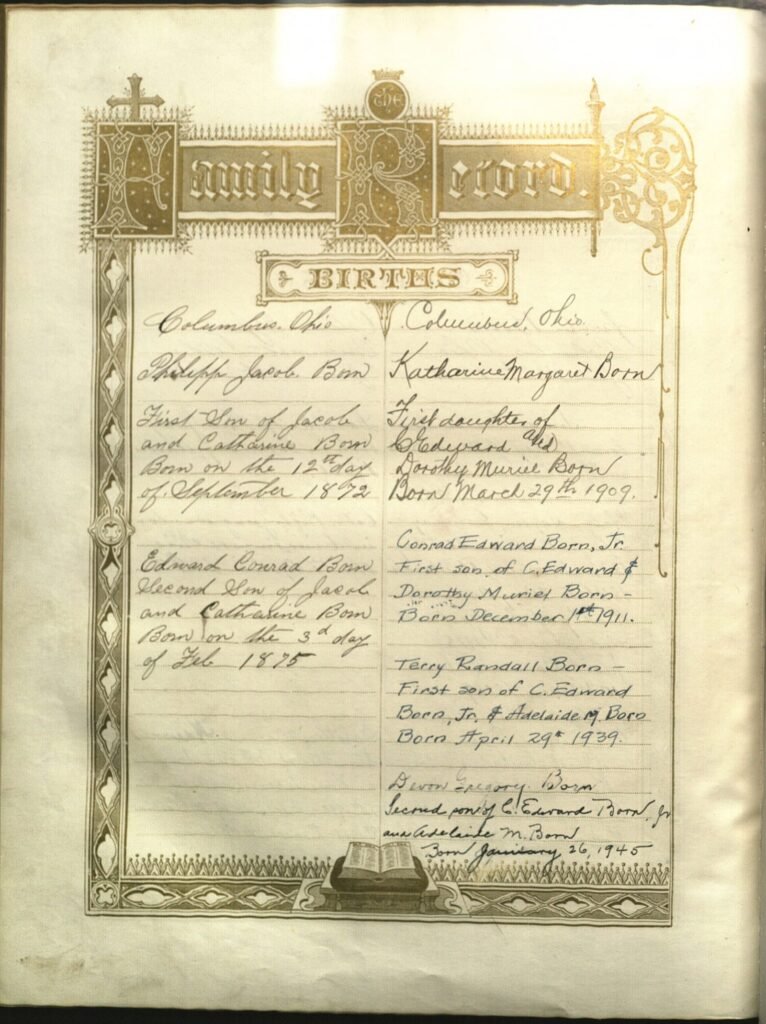
- Family Bible entry
- Insurance, employment or military document
- Affidavit by a parent, older relative, midwife or family friend
- Marriage record or another document showing age and parentage
Why it helps Polish-American research
The applicant was American-born, but the form or supporting affidavits may name both foreign-born parents, the mother’s maiden name and the family’s residence shortly after immigration. The witness may be an aunt or grandparent whose own records lead to the Polish village.
Where to look
Custody varies by state and county. Search the state vital records office, state archive and local court or county clerk. Illinois Regional Archives Depositories list delayed birth certificates among local government holdings, illustrating why a state archive catalog can be more useful than a broad commercial name search.
Evaluate the evidence date
A baptismal record made soon after birth generally carries more weight than an affidavit signed fifty years later. Record who supplied each fact, when the supporting document was created and whether the parents were still alive.
Read a real delayed certificate: Richard Berntson
The Utah State Archives publishes an actual delayed certificate for Richard Berntson, state file number 18500. It records an October 31, 1862 birth in Salt Lake City and County, Utah, and was filed on August 16, 1950. His parents are named as Rasmus Berntson and Laura Lundberg, both born in Sweden. This is a Swedish immigrant family, used here to demonstrate the American record format; it is not a Polish family or a PoloniaRoots client case.
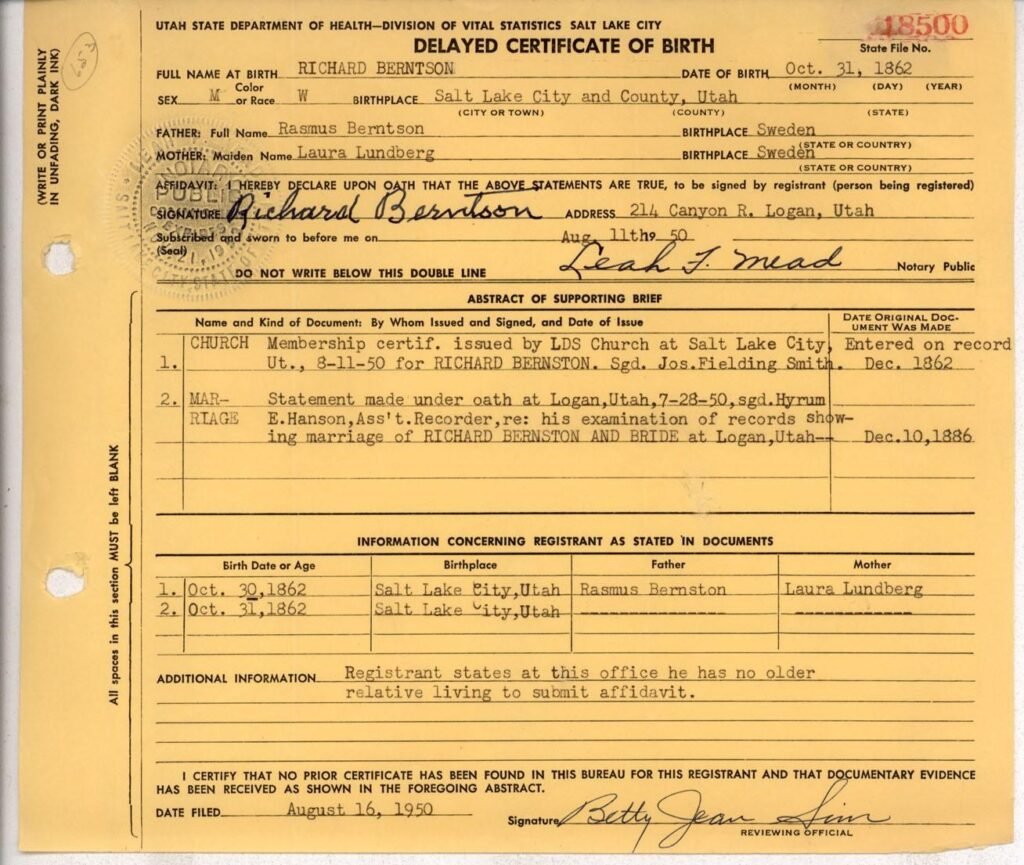
| Part of the document | What this certificate shows | Research consequence |
|---|---|---|
| Birth statement | October 31, 1862; Salt Lake City and County, Utah | Search contemporary local and church records under this place and date. |
| Parents | Rasmus Berntson and Laura Lundberg; Sweden for both birthplaces | The mother’s maiden name is a lead, but a country alone does not locate an overseas parish. |
| Supporting church record | A membership certificate issued August 11, 1950, referring to a record entered in December 1862 | Separate the date of the extract from the date of the underlying entry. |
| Supporting marriage record | A sworn statement dated July 28, 1950, describing a marriage record dated December 10, 1886 | Request the underlying marriage entry rather than treating the later statement as the original. |
| Conflicting birth dates | The supporting-document table gives October 30 in one row and October 31 in another | Preserve both readings. The certificate’s chosen date does not erase the disagreement. |
| Additional information | The registrant states that he has no older relative living to submit an affidavit | Check what evidence was accepted in this individual case instead of assuming a relative testified. |
| Filing date | August 16, 1950 | Keep the birth event in 1862 and the registration event in 1950 separate in your timeline. |
For a child of Polish immigrants, use the same method: transcribe the parent names as written, note whether a birthplace is a town or only a country, and obtain the older records cited in the evidence table. A marriage record may help connect the parents, while a baptismal entry may supply sponsors who were relatives. Those relationships still need independent confirmation.
A later copy is not necessarily a delayed registration
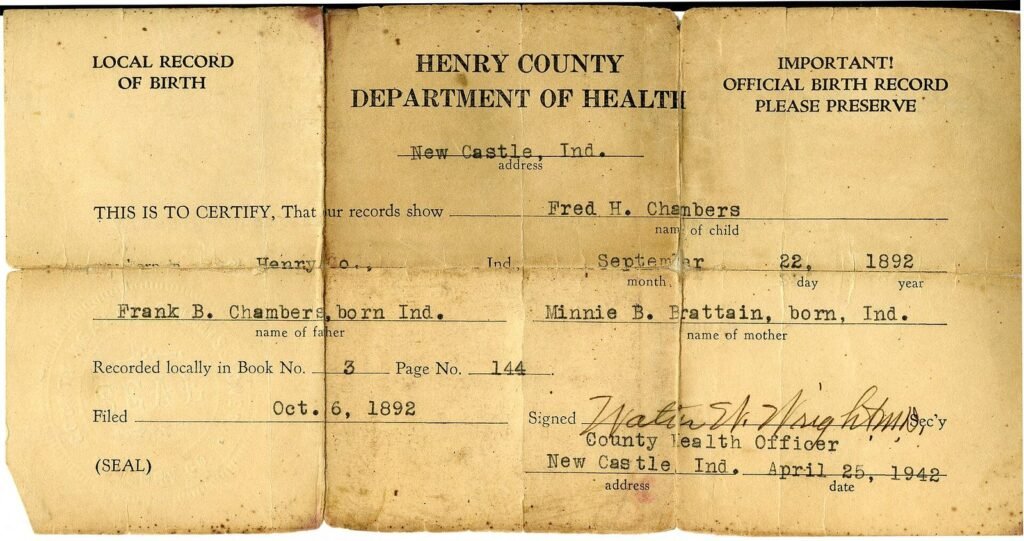
The Fred H. Chambers document shown near the beginning of this guide offers a useful caution. The Indiana Memory catalog describes it as a delayed birth certificate, but the visible form says that his September 22, 1892 birth was filed on October 6, 1892, in book 3, page 144. The county health officer signed this copy on April 25, 1942. Those dates support a later-issued copy of a promptly filed local record. Obtain the original ledger entry before concluding that the birth itself was first registered in 1942.
The copy names Frank B. Chambers and Minnie B. Brattain, both born in Indiana. New Castle is the health department’s address; the birthplace field says Henry County. Do not turn the issuing office’s address into a more precise birthplace than the document supplies. You can inspect the full scan and its source information through Indiana Memory and Wikimedia Commons.
Keep a citation that leads back to the document
For the Utah example, record the person’s name, state file 18500, the birth and filing dates, Utah Office of Vital Records and Statistics delayed certificates of birth, Series 81445, and the archive’s scan URL. For Chambers, record the issuing agency, the 1942 copy date and its reference to book 3, page 144. In both cases, save an access date and distinguish your transcription from the archive’s catalog description.
The Utah archive provides free browsing and a name search for its delayed birth collection. Its published explanation traces the evidence requirements and the expansion of delayed registration during the 1940s. Use that state-specific guidance for this example; requirements and access restrictions in another state may differ.
Do not merge a delayed certificate with an original registration in your notes. Cite the delayed filing date and every supporting item separately.
Sources and research tools
- Utah State Archives: delayed certificates and supporting evidence
- Utah State Archives: browse delayed birth certificates
- Indiana Memory: Fred H. Chambers birth-record copy
- Illinois State Archives: local records in the IRAD system
How we can help
We locate delayed registrations and their supporting files, then test the parent names against parish, census and immigration evidence.