US Records · Baltimore passenger lists
Baltimore was a US immigration port with its own passenger-record collections. A search focused only on New York can miss the arrival. Begin with a likely date and confirm Baltimore in a naturalization record, family paper or passenger index before following a same-name traveler.
An early Baltimore passenger list from 1834
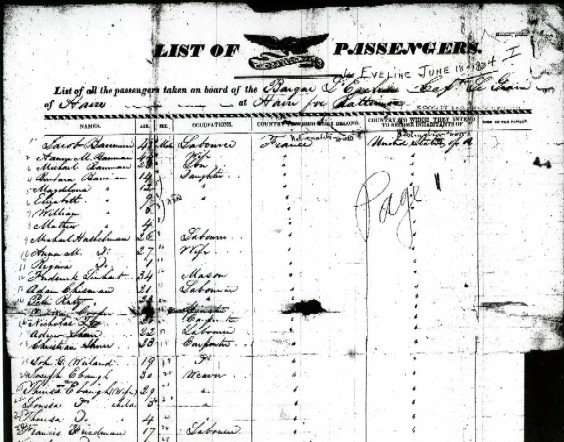
This image uses a short printed table rather than the detailed two-page immigration form familiar from the early twentieth century. Its headings ask for names, ages, sex, occupations, country of origin and destination information. It does not provide the later form’s dedicated columns for a nearest relative abroad or a contact’s complete American address.
The record’s age limits what questions it can answer. A country label and a common surname cannot establish a Polish village. Use the ship, arrival date and family group to connect the traveler to later records. This is a genuine early example of the Baltimore series, not a sample of what every Baltimore arrival form looked like.
How early and later passenger lists differ
| Document feature | Research implication |
|---|---|
| Early customs-era table | Often fewer family and birthplace details; a household group can still matter |
| Later immigration-service form | More questions, sometimes on two pages; inspect the actual headings |
| Name index or search result | A locator that may misread names and omit context |
| Manifest image | The original layout, traveling companions and annotations |
NARA explains that federal passenger-arrival reporting followed the Steerage Act of 1819, with systematic records beginning around 1820 and varying survival. Search the Baltimore series appropriate to the year. A modern database title can combine material from different forms and periods.
Where to begin a Baltimore search
- Find an approximate arrival year in censuses, family papers or a naturalization petition.
- Check NARA’s passenger-arrival guide for Baltimore series and coverage.
- Search available partner databases by name variants and date range.
- Record ship, arrival date, port, page and line for each plausible result.
- Read the complete manifest and compare companions with later US household members.
- For later forms, inspect the second page and any linked detention or annotation references.
Indexes offered by commercial providers and FamilySearch can differ in transcription and image availability. A failed search on one platform is not a complete search of every surviving Baltimore arrival. If a ship and date are known, browsing can resolve a surname that the index badly misread.
Identifying a Polish ancestor on an early list
Preserve the country as written. A traveler from the Polish lands can have been recorded under a partitioning state. That clue helps frame research but does not prove ethnicity. Compare age, occupation, companions and the first American residence. Several matching details are needed when a name is common or abbreviated.
Follow a traveling group into a census or church marriage. A relative’s later naturalization can reveal a more precise origin than the ancestor’s early passenger list. Search spouses and siblings, not only the person who carries the surname in your direct line.
Port of arrival and final destination
Baltimore is the point of arrival recorded by the port, not necessarily where the immigrant settled. The destination field can be broad, and onward travel may have occurred without a separate ocean passenger record. Use directories, parish records and censuses to trace the family after landing.
If the evidence points instead to Philadelphia, Boston, New York or Canada, search those routes separately. Do not move a same-name Baltimore traveler into the family merely because the expected New York search was unsuccessful.
Sources and research tools
- NARA: early Baltimore manifest and the 1819 reporting law
- NARA passenger arrival research guide
- NARA immigration overview
How we can help
We compare immigration documents with American family records and records in Poland, tracing identities, relatives and places across the journey. See our services for project scope and prices.