US Records · Utah birth records
Utah birth research involves early city registers, county records and statewide certificates from 1905. Some public records are indexed, others must be browsed or requested. The State Archives’ series descriptions explain both coverage and gaps.
A delayed Utah certificate with an earlier birth
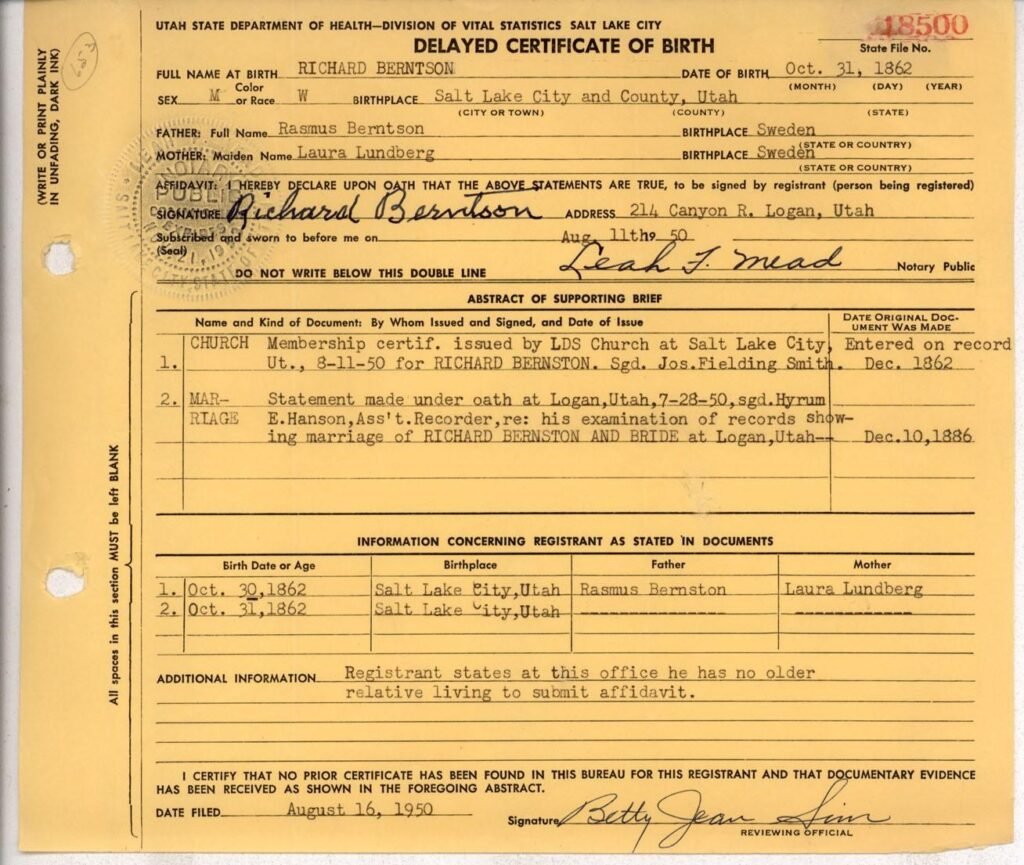
This example concerns an 1862 birth, long before statewide certificates. The later form lists evidence supplied to establish it, including a church birth-and-baptism record and marriage evidence. The parents are recorded as Swedish-born. It illustrates the Utah record system; it is not presented as a Polish-family case.
The supporting rows do not agree perfectly on the day of birth: October 30 and October 31 appear in the evidence. A careful transcription retains that conflict and distinguishes the date of the underlying event from the date when a supporting extract was issued. Our separate delayed-certificate guide analyzes the example in detail.
Choose the Utah record series by period
| Period | Where to investigate |
|---|---|
| Before 1898 | Selected city registers, including early Salt Lake City, Ogden and Park City records; church sources |
| 1898 to 1905 | County birth registers and local series |
| 1905 onward | State birth certificates, series 81443 |
| A birth registered late | Delayed certificates, series 81445, searched separately |
The archive’s birth guide distinguishes these systems. A person born in Utah in 1862 should not be expected in the ordinary 1905 certificate series under the year of birth. A later delayed record may instead be found under its filing arrangements and evidence.
Name searches and browsing are different routes
The Utah birth index page separates name-indexed years from certificates available only by browsing or request. It also links Soundex index books. Check the current page rather than treating a dated announcement about digitization as the present coverage limit. A public record can be available to researchers while its online name index remains incomplete.
- Establish the event date and county or city.
- Select the appropriate ordinary, local or delayed series.
- Search the name index where that year is covered.
- If necessary, browse by year and county or use the Soundex finding aid.
- Request a public record not yet available online and retain the series and file reference.
Public access does not mean every year is online
Utah birth certificates become public 100 years after the date of birth. Transfers and digitization can lag behind that boundary. At the source check, the archive’s page described a transfer still in progress for 1925 records and directed requests to the Office of Vital Records and Statistics in the meantime. Verify the live instructions when making a request.
Compare the local and state record
A local registrar’s copy and the state certificate can preserve the same birth in different collections. Read the local series inventory for missing years. A gap in one district register does not establish that the state original is also missing. Keep both references when you find two versions.
For a family with European roots, use parent names, residences and supporting church evidence to identify the household before searching overseas. A delayed certificate can guide you to an earlier source, but its later approval does not erase conflicts between those sources.
Sources and research tools
- Utah State Archives birth guide
- Current Utah birth index and browsing options
- Example and delayed series
- Local registrar copies and reproduction terms
How we can help
We compare American records with parish and civil records in Poland to establish the family connection and identify the ancestral village. See our services for the available research projects.
Keep reading
Detailed delayed-certificate example