US Records · Massachusetts birth records
Massachusetts birth research usually starts with the town or city. Statewide vital-record returns begin in 1841, while some local records are much earlier. The state archive and the Registry of Vital Records and Statistics hold different date ranges.
A Boston birth preserved in a later extract
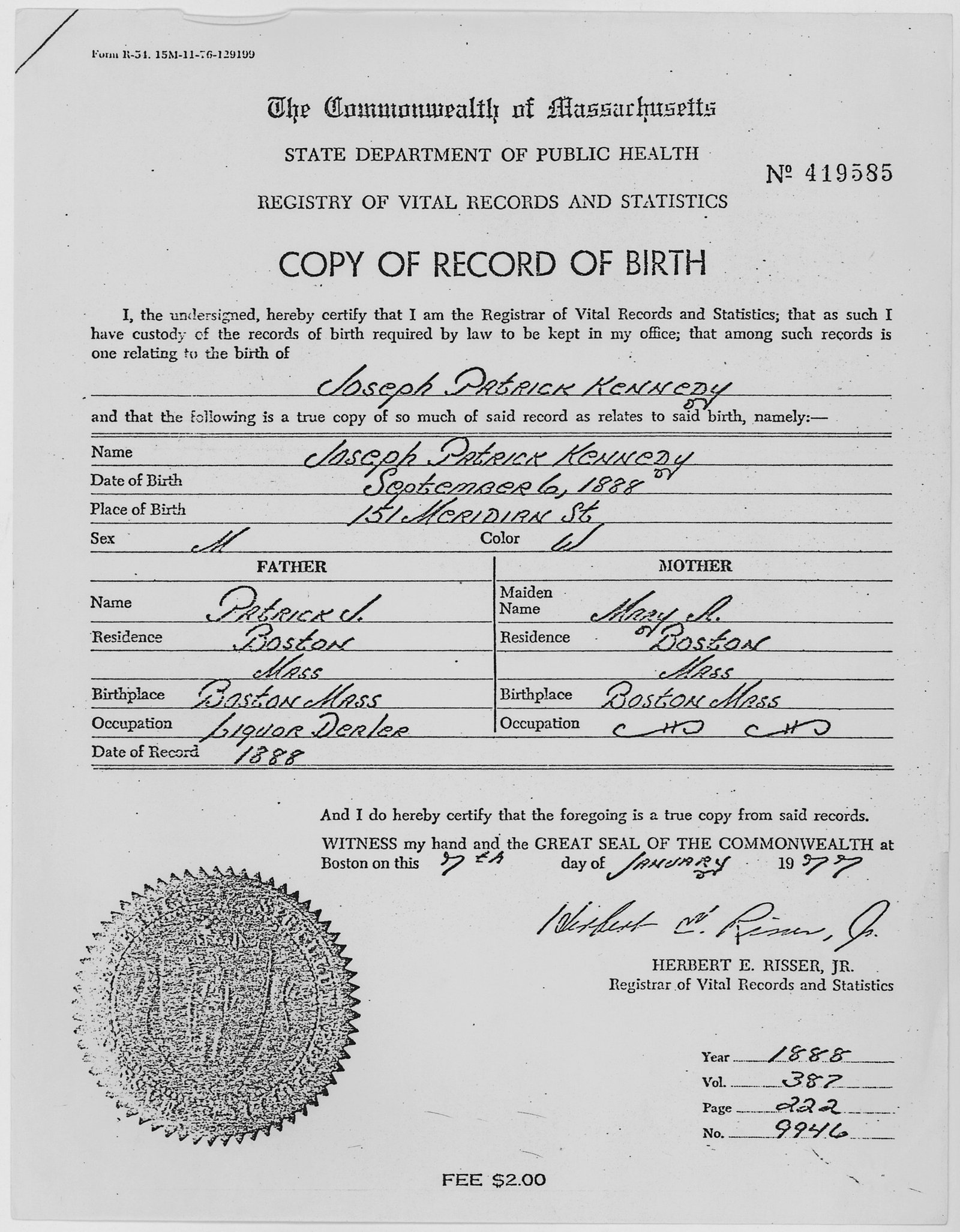
The document gives September 6, 1888, for the birth and a handwritten street address for the place. It names Patrick J. and Mary A. in the parent sections, reports Boston, Massachusetts, for their birthplaces and supplies a year, volume, page and entry at the bottom. The certification date is almost 89 years after the event.
The father’s surname is not expanded in his name field, and the mother’s maiden-name field gives only Mary A. A family historian should not fill in either omission from a biography without labeling that separate source. The extract says it copies only the part of the underlying record relating to the birth. Requesting the register page can therefore be more useful than accepting this form as a full transcription.
Where to search by date
| Period | Main research route |
|---|---|
| Before statewide returns in 1841 | Town or city records and surviving local compilations |
| 1841 through the current archival cutoff | Massachusetts Archives vital-record returns |
| 1936 and later under the current division | Registry of Vital Records and Statistics research procedures |
| Any historical period with surviving local records | The relevant city or town clerk and local archive |
The Massachusetts Archives currently lists returns through 1935. Older guides that stop at 1930 may predate a transfer. Consult the live archive page and the Registry’s genealogy instructions before planning a visit or ordering a copy. A transfer of custody does not guarantee that every new year is indexed online.
Local record, state return and printed transcription
A town register, the return sent to the state and a published town vital-record book can present the same event differently. Record which one you actually used. A printed transcription may normalize handwriting or omit annotations. When a maiden name is incomplete, compare the local record and state return instead of treating an abbreviated printed entry as the final evidence.
- Identify the town or city at the time of birth.
- Search its historical birth record and any applicable state return.
- Save the year, volume, page and entry reference.
- Inspect the full page and check for reporting dates or marginal additions.
- Compare the parents’ marriage and births of siblings in the same locality.
Following a Polish family in New England
The town can matter more than the county. An ancestor described as born near Springfield may have a record in a nearby municipality with its own clerk. Use a birth address or parish record to establish that locality. For immigrant parents, compare every foreign birthplace exactly as written before deciding that two entries concern the same village.
A US-born child’s certificate may name only a parent’s country. The parent’s naturalization petition, marriage and church records can supply a town. Preserve the connection between the child and the parents before pursuing a similarly named family in Poland.
When a later copy omits the detail you need
Ask the custodian which fields survive in the register and what kind of genealogical copy is available. Cite the event and later copy dates separately. A seal authenticates the issued copy; it does not show that every original field was reproduced or that every reported fact was independently verified.
Sources and research tools
- Massachusetts Archives vital-record collections
- Registry genealogy research instructions
- NARA catalog record 192708
How we can help
We compare American records with parish and civil records in Poland to establish the family connection and identify the ancestral village. See our services for the available research projects.