US Records · Reading naturalization petitions
A naturalization petition can name a birthplace, spouse, children and a qualifying arrival. The reverse may contain witness statements, the oath and the court’s decision. Reading only the indexed front can miss the date citizenship was actually granted.
The front of a real petition
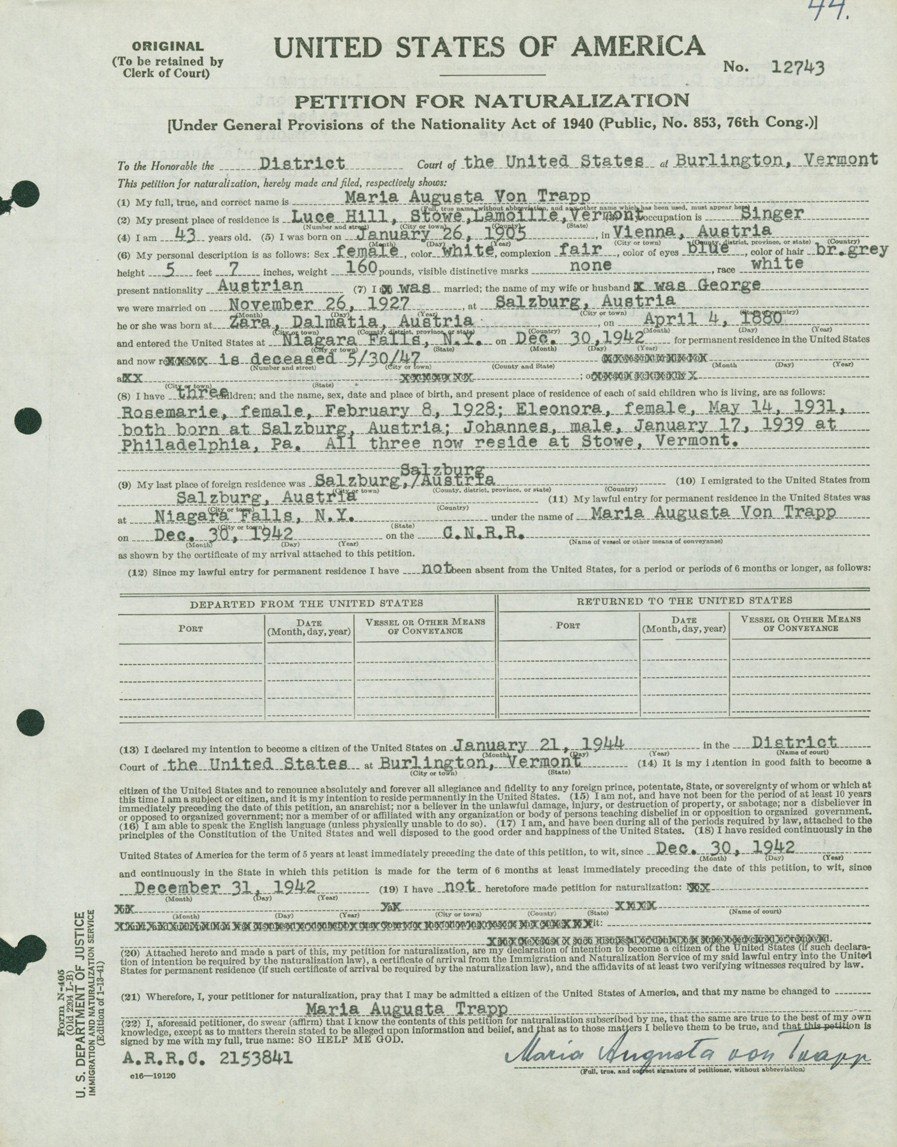
The petitioner gives Vienna, Austria, as her birthplace and Stowe, Vermont, as her residence. The form names her spouse, marriage information and three children, including Johannes, born in Philadelphia in 1939. A child’s American birthplace provides a separate vital-record search target; it is not the parent’s birthplace.
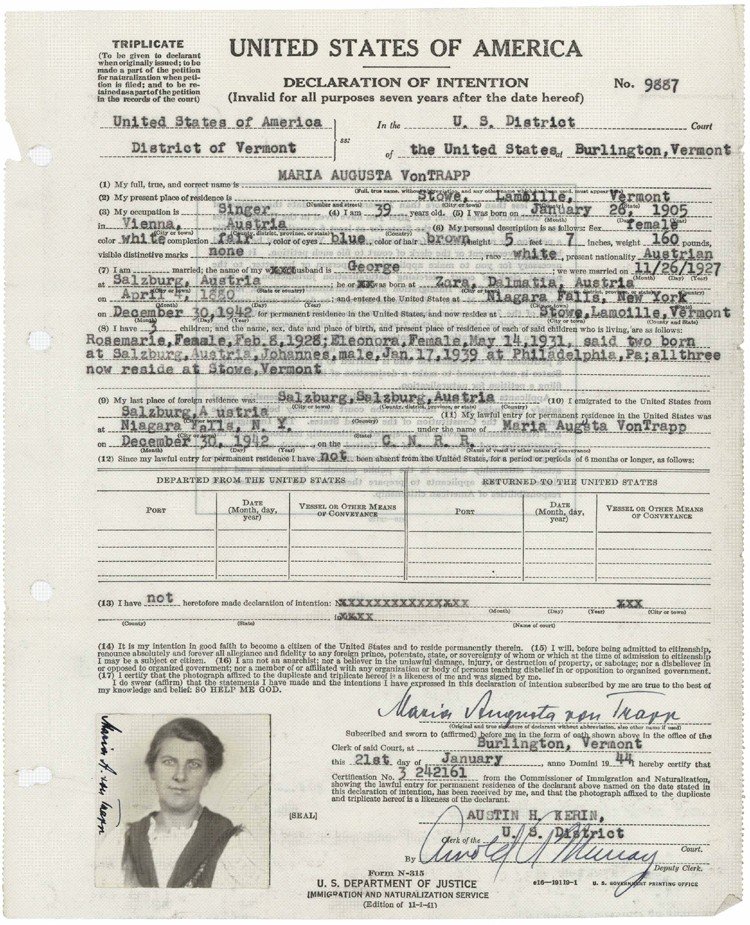
Her lawful permanent entry is stated as Niagara Falls, December 30, 1942, by C.N.R. The form also refers to a January 21, 1944, declaration of intention. These are different stages in the case. The petition’s assertions should be compared with its attachments and final court action.
The reverse supplies the oath and decision
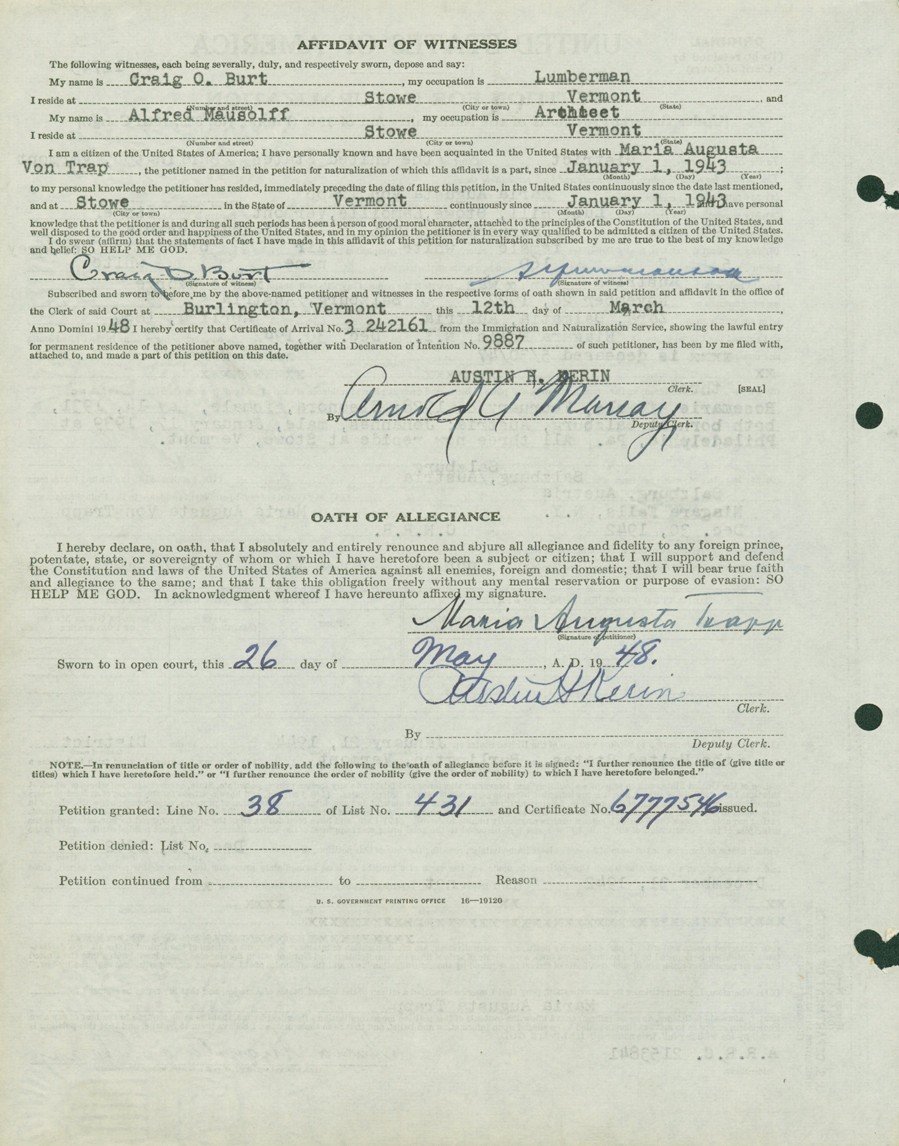
The reverse names two witnesses and contains a March 12, 1948, certification. The oath is dated May 26, 1948. The bottom records that the petition was granted and gives an associated certificate reference. The declaration date on the front is therefore not the naturalization completion date.
| Part of the file | Question it answers |
|---|---|
| Personal and family section | Who is applying, and which household does the person belong to? |
| Arrival section | Which admission is being used for the application? |
| Declaration reference | Where is the earlier statement of intention? |
| Witness affidavits | Who supplied testimony and from what claimed acquaintance? |
| Oath and disposition | Was the petition granted, denied or continued, and when? |
Locate the whole court file
- Identify the court from a certificate, index or earlier declaration.
- Record petition number, name and approximate filing date.
- Check NARA for the relevant federal court records or the custodian of a nonfederal court.
- Request the complete surviving petition packet and attachments.
- Inspect the reverse and any order book or certificate reference needed to confirm the outcome.
Naturalization was handled by many courts. NARA’s holdings are not a single complete index of every county and state court. A family’s residential county and the court used for naturalization need not be identical. Follow the court named on the actual document.
Use birthplace and family fields for Polish ancestry
Preserve the place name as written and compare it with the declaration and passenger manifest. A birthplace may be anglicized, abbreviated or described under a historical country. Identify the modern locality only after resolving the spelling and administrative context. A same-name town in Poland is not enough.
A spouse’s maiden name and the children’s birthplaces can tie the petitioner to a known American household. Search those children’s birth certificates and the parents’ marriage. If the family section disagrees with another document, consider the date of the statement and subsequent family events before declaring an error.
Common reading mistakes
- Treating a declaration as proof that citizenship was completed.
- Using the first arrival in family history instead of the admission named in the petition.
- Ignoring a continued or denied petition.
- Assuming a witness must be a relative.
- Reading a foreign country label as a complete village identification.
A strong conclusion links the petitioner’s identity to the household and records the final outcome. Keep the petition, arrival verification and oath as distinct documents within the same case, each with its own date and purpose.
Sources and research tools
How we can help
We compare immigration documents with American family records and records in Poland, tracing identities, relatives and places across the journey. See our services for project scope and prices.