US Records · Immigrant visa files
Historical immigrant visa files can preserve foreign birth and marriage evidence as well as the US admission record. For a Polish immigrant admitted for permanent residence between July 1, 1924, and March 31, 1944, this record series deserves attention beyond the passenger list.
An official example of visa-file paperwork
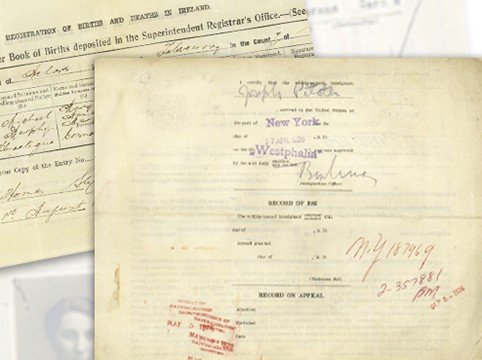
This is an official teaching image, not a complete readable file for a named Polish immigrant. The reverse carries arrival and later administrative notations, while another document is partly visible behind it. The gallery states that its examples have omitted data for privacy. A masked field should remain masked, and a blurred name should not be guessed.
The image demonstrates how a file differs from a single manifest row. An application, its reverse and supporting documents can each answer a different question. Obtain the full available file for the ancestor rather than expecting this representative illustration to show every possible attachment.
What a historical visa file may contain
| Document | Potential research value |
|---|---|
| Visa application | Parents’ full names, mother’s maiden name and minor children |
| Reverse and admission notations | Port, date, conveyance and inspection or later verification |
| Birth or marriage evidence | A foreign locality and family relationships |
| Health, police or military documentation | Additional identity and residence evidence |
| Support affidavit where required | A sponsor and the circumstances of support |
The USCIS gallery describes Forms FS-256 and FS-257 and notes that supporting documents vary by case. An unavailable official birth record could be replaced by other evidence. A married couple’s marriage certificate may appear in only one spouse’s file. Search both spouses before assuming a missing attachment never existed.
INS visa files and consular records are different searches
The historical INS visa-file series used for genealogy is not the same as every visa-related record held by the Department of State. NARA’s State Department guide describes surviving individual visa cases for 1914 to 1940, with selective preservation in earlier segments. It does not promise a consular file for every immigrant admitted under the later visa system.
- Confirm the person’s permanent-residence admission date from a manifest or naturalization record.
- Determine whether the historical INS visa-file period fits.
- Use the USCIS Genealogy Program’s current index-search or record-request instructions.
- Supply a valid file reference when known and required proof of death where applicable.
- Investigate a transferred A-file if the case was later reopened and older documents moved into it.
- Use NARA’s separate consular guidance when there is evidence for a State Department case.
How a visa file can identify a Polish village
A foreign birth extract may name a parish or civil registration office that the American passenger list abbreviates. Transcribe the original locality and compare any English translation. The issuing office, document date and language help identify the correct Polish or predecessor administration.
Do not treat a later foreign extract as the original register page. It may omit witnesses or marginal notes. Use its reference to seek the underlying entry in the relevant archive. Keep the immigrant’s application statement distinct from the registrar’s certification and from a sponsor’s affidavit.
A request is not an unrestricted online download
The representative gallery is freely viewable, but obtaining an individual historical file can require a paid search or copy request and eligibility documentation. Check the current official process and fees before ordering. A public example does not establish that every file is online, transferred to NARA or available without redactions.
Sources and research tools
- USCIS visa-file image gallery
- USCIS Genealogy Program
- NARA Department of State visa records
- NARA A-file holdings and transferred papers
How we can help
We compare immigration documents with American family records and records in Poland, tracing identities, relatives and places across the journey. See our services for project scope and prices.