US Records · Alien files at NARA
An A-file is a collection of immigration case papers associated with a person’s alien registration number. It can preserve documents created over many years. Start with NARA’s catalog to establish whether the specific file has been transferred and where it is held.
A genuine document inside an A-file
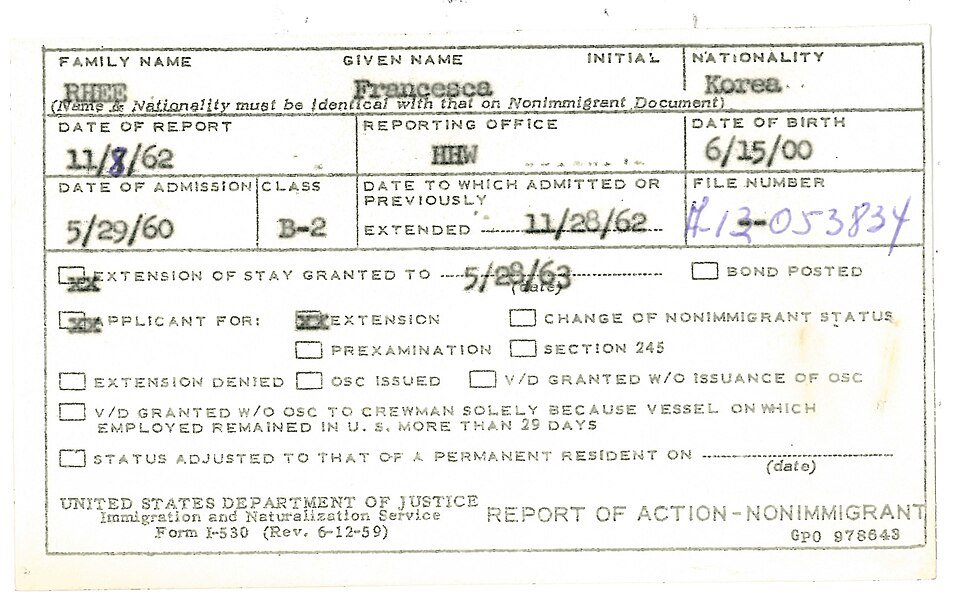
The form names Francesca Rhee, gives Korea as nationality and records a birth date of June 15, 1900. It lists May 29, 1960, for admission and B-2 as the admission class. The reporting office is HHW and the report date is November 8, 1962. The checked extension section and its date concern an administrative action on her stay.
This is a nonimmigrant action report, not proof of an immigrant admission or naturalization. Nationality is not the same field as birthplace. The file’s catalog describes Rhee as Austrian-born; a researcher who treated Korea in this form as her birth country would misread the question.
A-file, A-number and AR-2 are not interchangeable
| Term | Meaning for research |
|---|---|
| A-number | Identifier associated with the person’s immigration record |
| AR-2 | Alien registration form from the earlier registration program |
| A-file | Case file created under the system begun in April 1944 |
| NARA Identifier | Catalog reference for the archival file description |
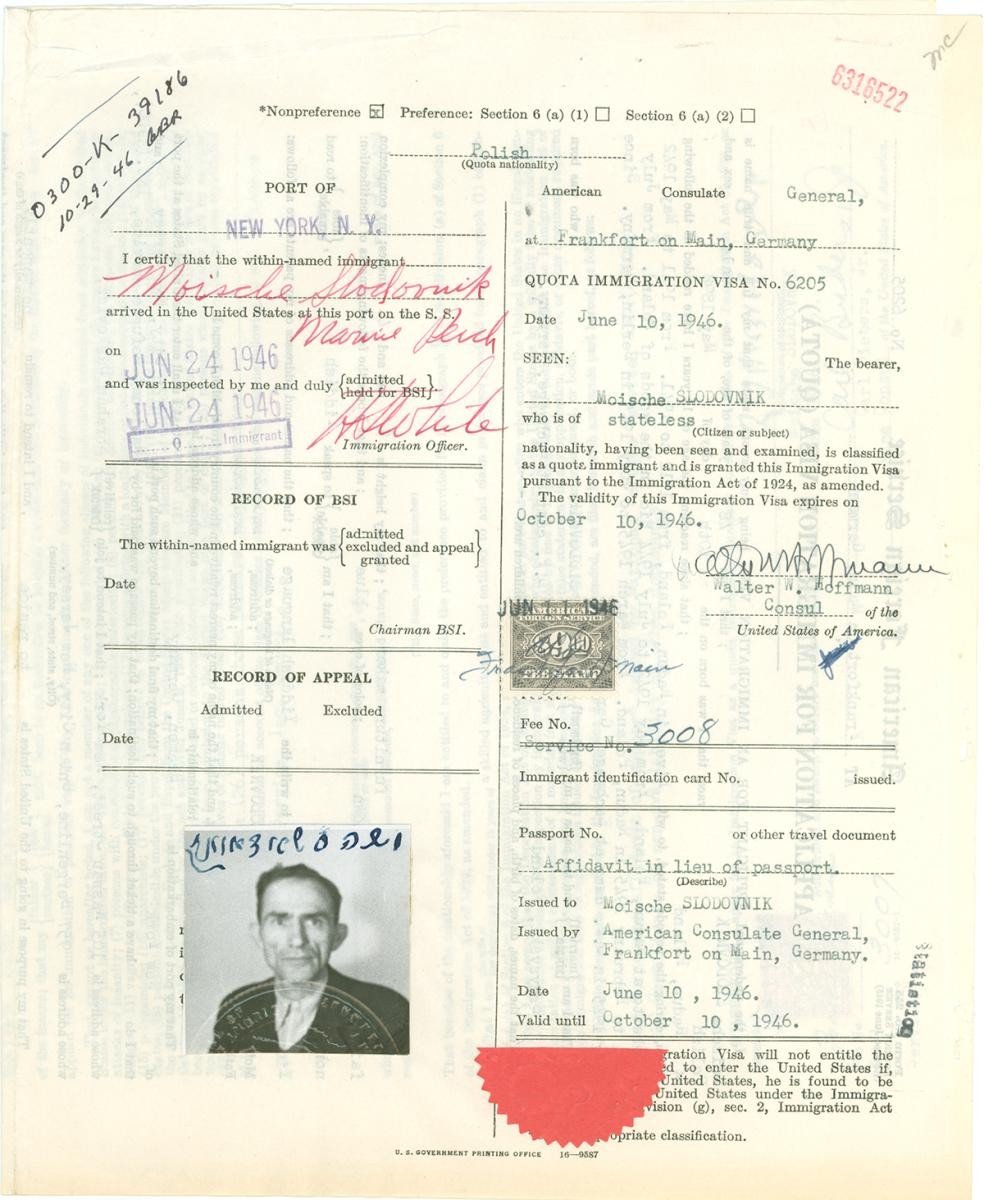
NARA explains that some earlier visa or other papers were moved into A-files when cases reopened. A file begun after 1944 can therefore contain older evidence. The existence of an AR-2 does not mean an A-file is also available at NARA, and an A-number alone does not show the person became a citizen.
Who holds the file?
A-files become eligible for archival transfer 100 years after the person’s birth year, but eligibility is not proof of an actual transfer. Search the individual catalog entry. NARA centralizes most holdings at Kansas City, while San Francisco retains certain district-office holdings. The catalog’s contact field identifies the office to approach.
- Search the NARA Catalog with the full name and surname variants.
- Compare birth information, aliases and entry details with the known person.
- Save the National Archives Identifier and A-number.
- Read the contact and access fields to identify the holding office.
- Request the complete available file using the current NARA procedure.
- If no entry exists, investigate USCIS custody rather than sending an unsupported NARA request.
Read each paper according to its purpose
A file may combine an application, foreign certificate, photograph, correspondence and a later action report. The person making each statement and its date matter. An official file can contain an immigrant’s own account, a copied foreign record and an officer’s decision without making them equivalent sources.
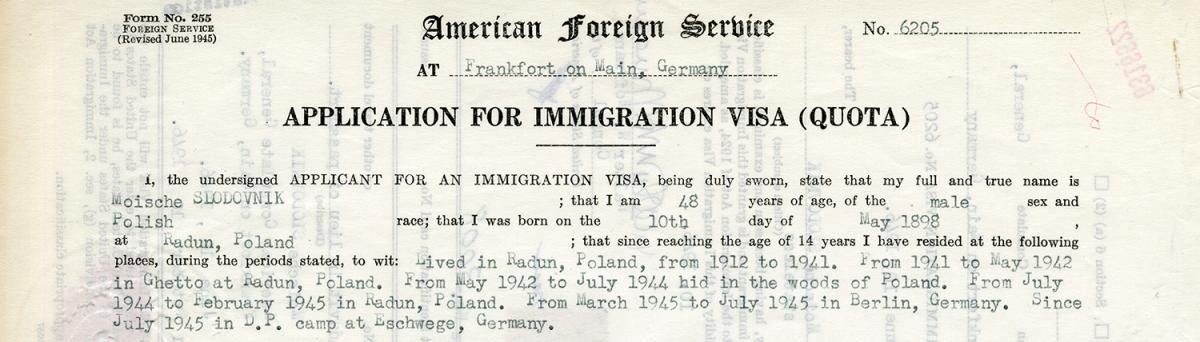
For Polish research, inspect original-language birth or marriage evidence and any translation side by side. Record historical place names before identifying the modern location. Use relatives and addresses to connect the file to the American family, especially when the surname changed spelling.
Catalog description does not mean digitized file
Many catalog entries describe files that must be requested rather than downloaded. A short description can omit the most useful supporting document. Third-party information may be redacted even when the subject’s file is open. Preserve source masks and record missing pages instead of reconstructing them from assumptions.
A careful report separates what the catalog says, what the viewed documents establish and what remains to be obtained. A-file research can add family evidence, but the contents and outcome vary with the individual case.
Sources and research tools
- NARA A-file guide and request requirements
- NARA catalog: Francesca Rhee file
- Full example scan via Wikimedia Commons
- USCIS Genealogy Program
How we can help
We compare immigration documents with American family records and records in Poland, tracing identities, relatives and places across the journey. See our services for project scope and prices.